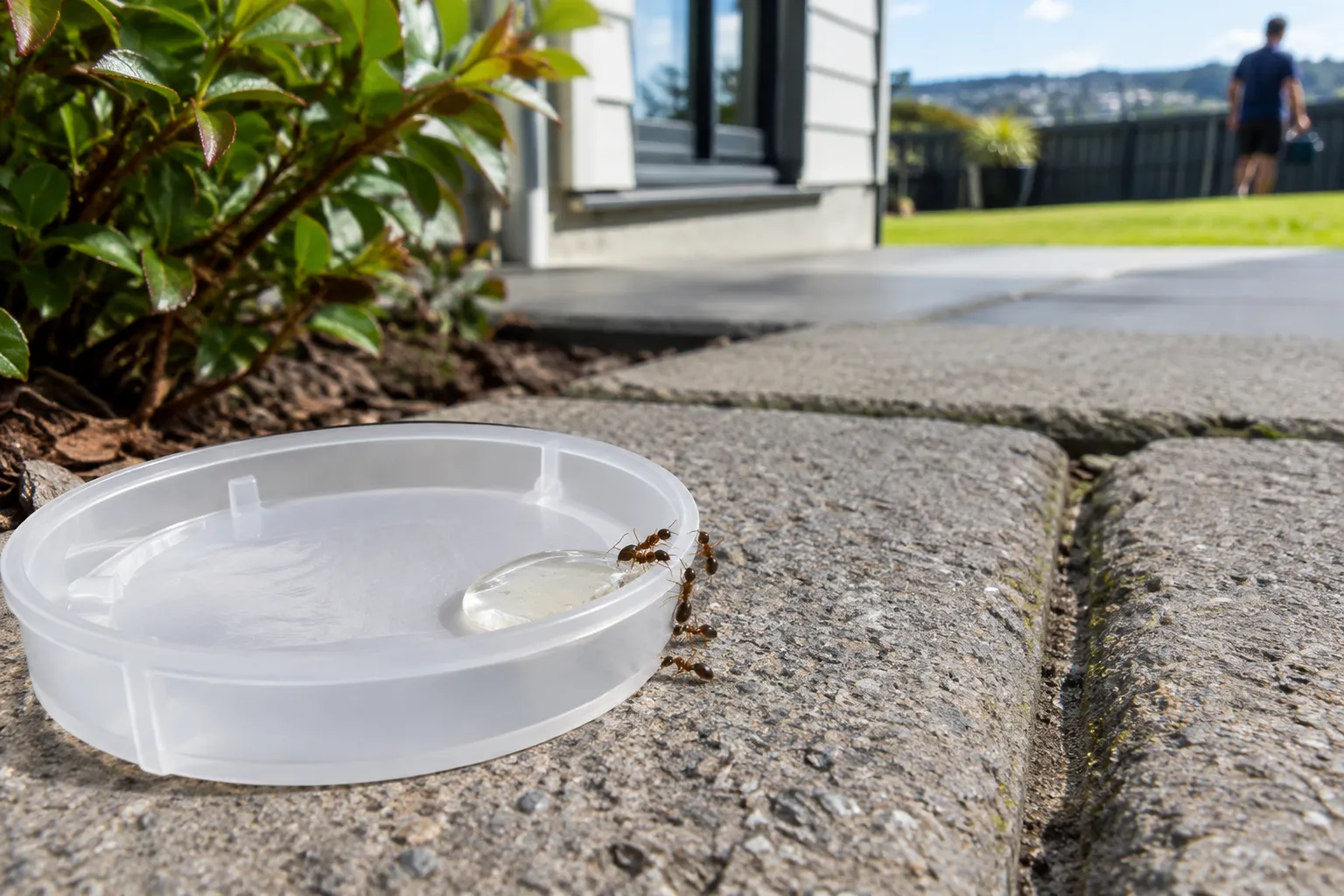
Ant bait is a slow-acting poison mixed into food that worker ants carry back to the nest and share with the larvae and queens. That's why it can kill a colony when a spray only kills the ants it touches. The catch: the bait has to suit your ant, and you have to leave it alone long enough to work. This page is part of our guide on how to get rid of ants. It covers sugar and protein baits, what's in the products sold in New Zealand, how to make a home-made borax bait, where bait stations go, and the common mistakes that stop baits working.
How does ant bait work?
Ant bait works by being eaten slowly. Workers find the bait, take it back to the nest and pass it on to other workers, the larvae and the queens. Because the poison acts slowly, it spreads through the colony before the ants die. Te Ara notes adult ants can only take liquids, so solid food goes to the larvae.
Three things decide whether a bait works:
- The food. Workers mostly eat sugar. Queens and larvae are fed protein. Landcare says protein baits are how New Zealand gets bait to the queens of Argentine ant nests.
- The poison. Common active ingredients in New Zealand ant baits are boric acid and sodium borate (borax) in sugar baits, and fipronil in baits aimed at Argentine ants.
- The dose. Too little bait gives the colony a sublethal dose. The Department of Conservation warns that can split the colony and make it harder to control.
Sugar or protein bait: which should you use?
Use a protein bait for Argentine ants, and a sugar bait for most other ants, such as Darwin's ant and the black house ant. If you're not sure, put out a little of each beside the trail and watch which one the ants crowd onto. Ants can switch between sugar and protein as the needs of the nest change.
| Bait type | Typical active | Best for | Notes |
|---|---|---|---|
| Sugar liquid or gel | Boric acid and borax | Darwin's ant, black house ant, many sugar-feeding ants | Kiwicare says its liquid bait controls Argentine ants only when they're sugar feeding |
| Protein or mixed gel | Fipronil 0.01% | Argentine ants | Recommended by DOC and Landcare outdoors. Very toxic to aquatic life |
| Granules | Various | Outdoor nests in lawns and gardens | Read the label for where it can be used |
Consumer NZ quotes a pest controller saying Argentine ants prefer protein and often ignore the sugar baits most shops sell. Landcare notes that some strong boric acid baits work on other ants but may be too strong for whole-colony control of Argentine ants, because the workers die before they share it.
White-footed house ants are the exception to all of this. Landcare says baits are often not effective on them, and Consumer NZ reports the ants learn to avoid baits. For those, see ants in the house.
How do you make a home-made borax ant bait?
A home-made borax bait is a small amount of borax dissolved in a sweet liquid, such as sugar water or honey and water, soaked into cotton wool or a bottle cap and placed beside the trail. The aim is a weak mix. Too much borax and the ants die before they reach the nest, so the colony survives.
How to use it safely:
- Make a small amount at a time, in a container you'll never use for food again, and label it.
- Keep the mix weak and very sweet. If ants stop visiting, it's too strong.
- Put it in a bait station or under an upturned container with a gap, so children and pets can't reach it.
- Place it right beside the trail, not on it.
- Leave it for one to two weeks and top it up as it dries out.
Borax and boric acid are not harmless. Kiwicare's boric acid bait labels warn that the product is suspected of damaging fertility or the unborn child. If anyone swallows bait, call the National Poisons Centre on 0800 764 766, free and open around the clock.
How can I make protein ant bait?
People usually make a protein bait from a small amount of something like peanut butter, canned tuna or egg yolk, mixed with a little borax and placed beside the trail. It mimics the protein that colonies need for their larvae. Make tiny amounts, check it daily, and replace it once it dries. Keep it out of reach of pets, who'll find it attractive too.
Where should you put ant bait stations?
Put bait stations right beside the trail, close to where the ants come in, and use plenty of them. Kiwicare's instructions place its stations about 30 cm apart where ants have been seen, and check them daily. Outside, the Department of Conservation suggests putting many stations along paths, structures, fences, garden borders and rock walls.
Tips that make stations work:
- Put them where ants already travel, not where you'd like them to go.
- Keep gel and paste baits out of direct sun, and refresh liquid baits as they dry.
- Don't clean around the station with strong cleaners. The smell can put ants off.
- Keep fipronil baits out of drains and gutters and at least 3 metres from waterways, as Landcare advises.
Why can ant spray stop a bait working?
Spray stops a bait working because it kills or scatters the workers before they can carry the bait home, and repellent sprays teach the colony to avoid the area. Landcare advises waiting at least a week after baiting before using any residual insecticide. Consumer NZ notes that spraying outdoor trails of white-footed ants can push them indoors.
Some sprays are designed to be non-repellent, so the ants walk through them and carry the poison home. Landcare lists bifenthrin and fipronil products as non-repellent options for paths and containment, but several are for approved handlers only. If you want a barrier spray, use it after the bait has done its work, not alongside it.
Does diatomaceous earth work on ants?
Diatomaceous earth is a fine powder sometimes suggested as a natural ant control. It can only affect ants that walk through it, so it does nothing to a nest inside a wall or under paving. We found no New Zealand authority that recommends it for Argentine or white-footed ants. Bait is the better choice.
Questions people ask
Do ant bait stations attract more ants?
Yes, at first, and that's a good sign. Bait stations draw foragers that were already nearby, so you'll see more ants on and around the bait for a day or two. They're carrying it back to the nest. Numbers should drop within one to two weeks. If they don't, the bait may not suit your ant.
What is the best homemade ant bait?
For sugar-feeding ants, a weak mix of borax in sugar water or honey and water is the most effective home-made bait. For ants that ignore sugar, such as Argentine ants in spring, try a small amount of peanut butter or tuna with borax. Keep every home-made bait out of reach of children and pets.
How long does ant bait take to work?
Most ant baits take one to two weeks to reduce a colony noticeably, sometimes longer for large Argentine ant colonies. You'll often see more ants at first. Landcare suggests repeating fipronil baiting for Argentine ants after six to eight weeks to catch survivors. Leave the bait alone while it works.
Is ant bait poisonous to dogs and cats?
Ant baits contain insecticides, and boric acid baits carry a warning that they are suspected of damaging fertility. Use bait stations or put baits where pets can't reach them, and store packets away from food and animals. If your pet eats bait, call your vet and the National Poisons Centre on 0800 764 766.
Will ant bait harm bees?
It can if bees reach it. Ant baits are insecticides, so place them close to ant trails, inside stations or under cover, and away from flowers, water and hives. Fipronil is highly toxic to insects generally. Read the label for where each product can be used outdoors.
Sources
- Manaaki Whenua Landcare Research: Argentine ant control tools
- Manaaki Whenua Landcare Research: Baiting operations
- Department of Conservation: Argentine ants
- Consumer NZ: The best ways to get rid of ants in your home
- Kiwicare: NO Ants Liquid Bait Stations technical sheet
- Kiwicare: NO Ants Liquid Bait safety data sheet
- Te Ara: Ants
- National Poisons Centre
Last updated