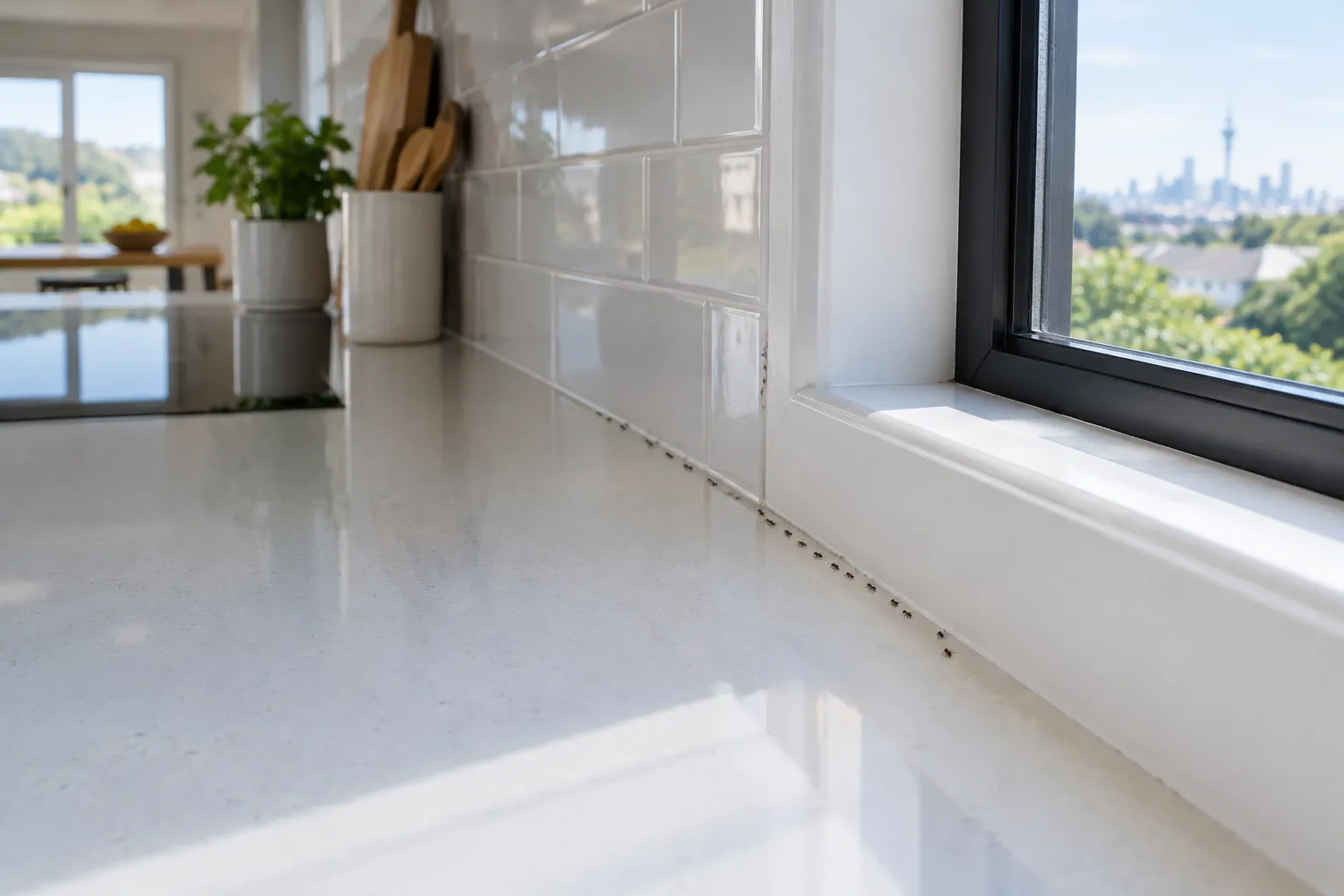
Most small black ants in New Zealand homes are white-footed house ants (Technomyrmex jocosus). Te Ara calls them the country's most common introduced ant, and they often nest inside walls and come out for water and sweet food. Two other black ant species are common around Auckland houses: the black house ant and dark forms of the native southern ant. Knowing which one you have matters, because white-footed house ants shrug off the shop baits that work on other species. This page is part of our guide to the types of ants in New Zealand. Below: how to identify them, whether they bite, what kills them, and when to get a specialist in.
Which black ants get into New Zealand homes?
Three black or dark ant species are common around Auckland homes. White-footed house ants are black or dark brown with pale legs and form long trails indoors. Black house ants are shiny black or brown and trail up tree trunks, coming inside only occasionally. Native southern ants can be black but forage in a scattered way rather than trails.
What Landcare's species fact sheets say about each:
| Ant | Workers | Nests | Indoors? |
|---|---|---|---|
| White-footed house ant | 3.0 to 3.4 mm, black or dark brown, pale legs | Wall cavities, rotting logs, under loose bark | Often, in high numbers |
| Black house ant (Ochetellus glaber) | 2.0 to 2.5 mm, shiny black or brown | Under stones, dry logs, holes in trees and fence posts | Occasionally |
| Southern ant (Chelaner antarcticus) | 3 to 5 mm, orange, brown or black | Soil under stones, rotting logs, lawns | Rarely |
Darwin's ant is the other one people describe as "black". Its head is dark brown but the rest of the body is light brown, and it smells strongly when crushed. It nests in pot plants and gardens and sometimes comes inside in large numbers looking for sweet food.
The black house ant came from Australia. Landcare's earliest New Zealand record is from Whangārei Falls in 1927, and it now lives in most of the North Island. Landcare says it isn't a major house pest here.
How do you tell white-footed house ants from other black ants?
Look for pale feet on a dark body and a long, steady trail that leads into a wall, skirting board, power point or window frame. White-footed house ants also tend to hold their abdomen up as they walk. If the trail disappears into the house rather than out to the garden, you very likely have white-footed house ants nesting in the building.
Other signs:
- Where the trail goes. Consumer NZ's expert says white-footed ants live in the inner walls, ceiling and subfloor and go outside for food. Most other ants do the opposite.
- What they're eating. They forage for water and sweet foods, so you'll see them at sinks, sugar, honey and pet water bowls.
- The hand test. Put your hand across a trail outside. White-footed ants scatter. Argentine ants walk straight over it.
- The numbers. Landcare says colonies can spread across many linked nests and contain millions of ants, so numbers can climb fast.
If the ants are light honey-brown instead, see our page on Argentine ants.
What kills black ants?
Slow-acting baits kill black ants best, because workers carry the bait back and share it with the queens and young. Sprays kill only the ants they touch. With white-footed house ants, baits are harder work: Landcare says the bait often isn't passed between workers, so large amounts are needed. A specialist can use professional products that shop sprays don't match.
What to do, depending on the ant:
- Black house ants and southern ants. These are usually garden ants. Clean up, seal gaps and use a sugar bait station where they trail. Our ant bait guide compares what's on sale.
- White-footed house ants. Don't spray the trails outside. Consumer NZ's expert says that cuts them off from garden food and pushes them to feed inside. Keep baits fresh, inside and out, and expect it to take a long time.
- Any ant indoors. The University of California's pest guide recommends wiping trails with soapy water, sealing entry points with caulk and storing food in sealed containers.
Consumer NZ reports one pest controller saying half-hearted DIY baiting can split a colony around the house, which makes professional treatment harder. If you plan to call someone in, it's often better to do it before you try a dozen products.
Keep baits and sprays away from children and pets. If anyone swallows one, call the National Poisons Centre on 0800 764 766.
Do black ants bite?
Most black ants in New Zealand homes are a nuisance, not a danger. Landcare's fact sheet says the black house ant doesn't sting, and that Darwin's ant can't sting either. Te Ara explains that some ants sting, some squirt formic acid and some bite, so you may feel a small nip if you disturb a nest.
The ants with a painful sting in New Zealand aren't black. The larger native Austroponera ants are reddish-brown and over 6 mm long. The red imported fire ant, which isn't established here, is reddish with a darker abdomen.
How can you tell if it's a carpenter ant?
You almost certainly don't have carpenter ants. Carpenter ants aren't on Landcare's list of the 38 ant species confirmed in New Zealand. A large dark ant around an Auckland home is more likely a native ant or a big-headed soldier of the coastal brown ant. If you find a big ant you can't identify, photograph it and check with the Ministry for Primary Industries.
MPI's advice is to photograph a suspect against a white background with a common object such as a 10 cent coin for scale. Its exotic pest hotline is 0800 80 99 66.
When should you get a specialist for black ants?
Call a specialist when ants keep coming out of walls, ceilings or power points, when baiting hasn't worked after a few weeks, or when numbers are rising. That pattern points to white-footed house ants nesting in the structure. Professional treatments are designed to work through the colony over time, and a specialist can confirm the species first.
Things to ask when you get quotes:
- Which species they think it is, and why.
- Whether they'll treat inside, outside or both.
- How many visits it's likely to take, and whether a follow-up is included.
- What you need to do before and after, especially with pets and children.
See what ant control costs in Auckland for published price ranges, and our page on ants in the house for what to check indoors.
Questions people ask
What happens if I get bitten by a black ant?
You'll usually feel only a small, sharp nip. Landcare says the black house ant and Darwin's ant don't sting. Wash the spot with soap and water and use a cold pack if it itches. If you're unsure, call Healthline free on 0800 611 116. Call 111 straight away if someone has trouble breathing or their face or throat swells.
What kills black ants instantly?
A household fly and insect spray or soapy water kills the ants it touches straight away. But it does nothing to the queens in the nest, so the trail comes back. To clear the colony, use a slow-acting bait instead and let the workers carry it home. With white-footed ants, avoid spraying the trails outside.
Why are there black ants in my bathroom?
Ants come into bathrooms for water. White-footed house ants forage indoors for water and sweet food, and they often nest in wall cavities, so a bathroom wall is an easy route. Fix drips, wipe the trail with soapy water and seal gaps around pipes. A steady trail out of the wall usually means a nest in the house.
What are the small brown ants in NZ homes?
Small brown ants in Auckland homes are usually Argentine ants, which are light honey-brown, or Darwin's ants, which have a darker head and smell when crushed. The native tiny brown ant is only about 1.6 mm and reddish-brown, and Landcare says it turns up in kitchens and bathrooms. The coastal brown ant lives in coastal Auckland suburbs.
Do I need to report black ants?
No. The common black ants in New Zealand homes are established species, and you don't need to report them. You do need to report anything that looks like a red imported fire ant, which is a notifiable organism. Call the Ministry for Primary Industries on 0800 80 99 66 and don't disturb the nest.
Sources
- Manaaki Whenua Landcare Research: Technomyrmex jocosus
- Manaaki Whenua Landcare Research: Ochetellus glaber
- Manaaki Whenua Landcare Research: Doleromyrma darwiniana
- Manaaki Whenua Landcare Research: Chelaner antarcticus
- Manaaki Whenua Landcare Research: Ants of New Zealand
- Te Ara: Ants
- Consumer NZ: The best ways to get rid of ants in your home
- University of California IPM: Ants
- Ministry for Primary Industries: Report a pest or disease
- National Poisons Centre
Last updated