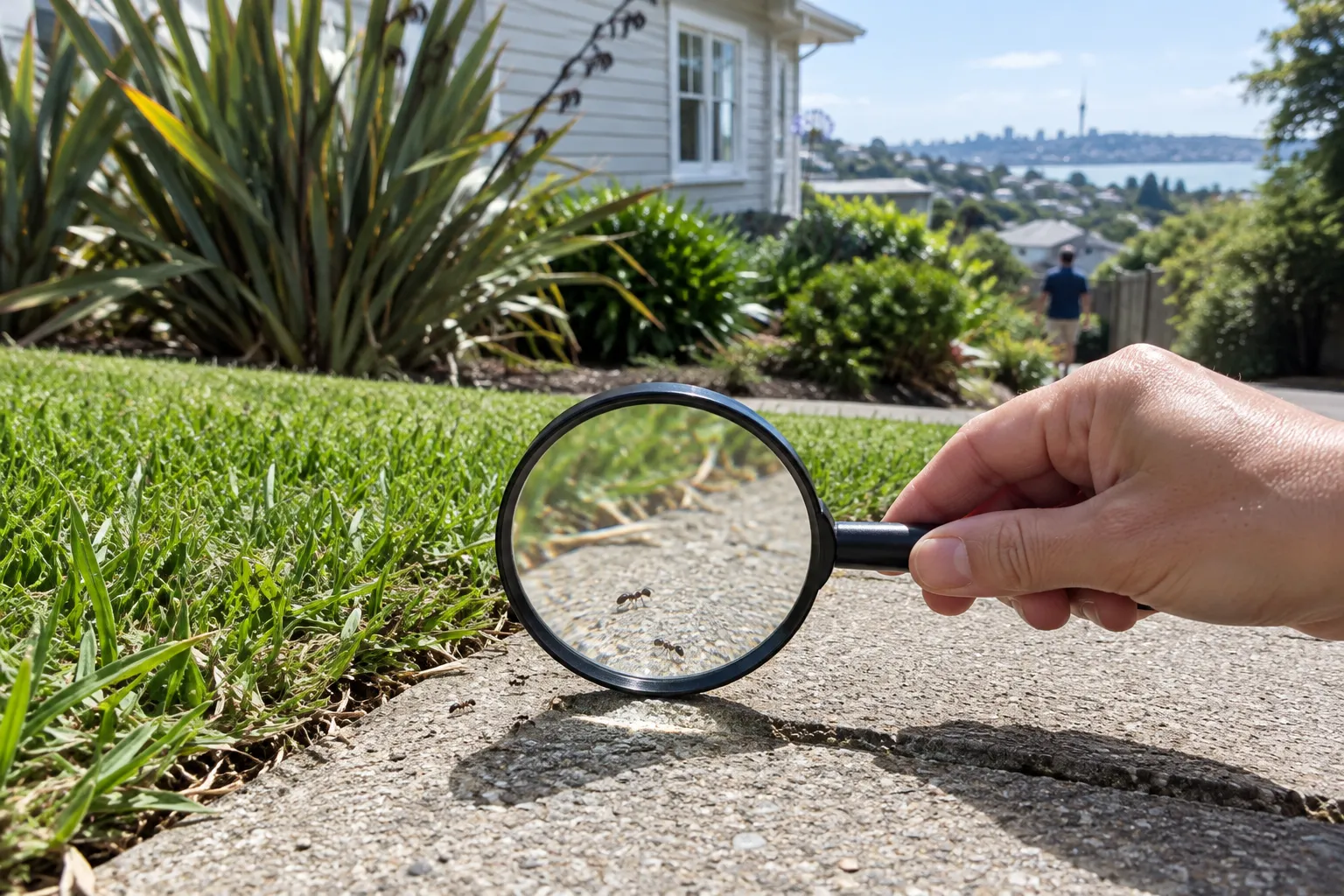
New Zealand has 38 confirmed ant species, according to Manaaki Whenua Landcare Research. Only 11 are found nowhere else. The other 27 arrived by accident with people, mostly from Australia. Around 15,000 ant species have been described worldwide, so our ant fauna is small. In Auckland homes, the ants you're most likely to meet are the white-footed house ant, the Argentine ant, Darwin's ant, the black house ant and the coastal brown ant. This guide is part of our wider page on ant control in Auckland. Below: how to tell the common species apart, which ones bite or sting, the one ant you must report, and why knowing the species changes the treatment.
What are the most common types of ants in New Zealand?
The most common ant overall is a native, the southern ant, which lives almost everywhere from forest to suburban lawns. Indoors, the most common invader is the white-footed house ant, followed by the Argentine ant. Te Ara calls the white-footed house ant the country's most common introduced ant. Consumer NZ names the white-footed and Argentine ants as the two main ants in New Zealand homes.
The species you're most likely to see around an Auckland house:
| Ant | Size of workers | Colour | Where you'll see it |
|---|---|---|---|
| White-footed house ant (Technomyrmex jocosus) | 3.0 to 3.4 mm | Black or dark brown, pale legs | Long trails into kitchens and bathrooms, nests in wall cavities |
| Argentine ant (Linepithema humile) | 2.2 to 2.6 mm | Light honey-brown | Wide, busy trails outside, swarms over pot plants, raids houses for food |
| Darwin's ant (Doleromyrma darwiniana) | About 2 mm | Dark brown head, light brown body | Potted plants and gardens, sometimes indoors in large numbers |
| Black house ant (Ochetellus glaber) | 2.0 to 2.5 mm | Shiny black or brown | Files up tree trunks and fence posts, occasionally indoors |
| Coastal brown ant (Pheidole megacephala) | 2 mm, with 3.5 mm big-headed soldiers | Light brown | Coastal Auckland suburbs, small soil mounds at nest entrances |
| Southern ant (Chelaner antarcticus) | 3 to 5 mm | Orange, brown or black | Lawns and gardens all over the country |
Sizes and colours are from Landcare's species fact sheets and Te Ara. You'll need a magnifying glass or a sharp phone photo to see most of these features.
How do you identify the ants in your house?
Start with colour, then watch how the ants behave. Black or dark ants in long trails indoors are usually white-footed house ants. Light brown ants in wide, close-packed trails are usually Argentine ants. If light brown ants smell strongly when you crush one, they're more likely Darwin's ants. Ants with a few big-headed soldiers among small workers point to the coastal brown ant.
The quick field tests the experts use:
- The pale feet. White-footed house ants have pale legs on a dark body. Landcare also notes they tend to raise their abdomen as they walk.
- The hand test. Consumer NZ quotes a pest controller: put your hand across a trail outside. White-footed ants scatter. Argentine ants walk straight over it.
- The smell test. Landcare says Darwin's ants give off a strong smell when crushed, while Argentine ants have little or no smell. This is the easiest way to separate two ants that look almost the same.
- The soldiers. The coastal brown ant and its close relatives have two sizes of worker. The bigger ones have a massive head for their body.
- The trail. The southern ant doesn't seem to use trail scents, so Landcare says its workers forage in a scattered way rather than in neat lines.
Our guide to black ants in New Zealand goes deeper on the dark species, and our page on Argentine ants covers the light brown one that worries councils most.
What are the three types of ants in a colony?
Every ant colony has three kinds of ant: queens, males and workers. Workers are wingless females that forage, build and care for the young. Queens lay the eggs. Males have wings, mate during a swarming flight with young queens, then die within a few weeks. Fertilised eggs become females, so queens and workers, and unfertilised eggs become males.
Te Ara explains the life cycle: egg, larva, pupa and adult, usually over six to ten weeks. Some queens can live for decades, and some workers for years.
Why it matters for you:
- The queens are the target. Killing the workers you can see doesn't stop the queens laying. That's why slow baits, which workers carry home and share, work better than sprays.
- Many-queen species are harder. Te Ara notes white-footed house ant colonies have many functional queens. Argentine ants form super-colonies with many queens. Removing one nest barely dents either.
- Some colonies don't share food evenly. Landcare says baits often work poorly on white-footed house ants because the bait isn't passed between workers, so large amounts are needed.
How many ant species are there in New Zealand?
New Zealand has 38 confirmed ant species from 23 genera, according to Landcare Research. Eleven are endemic, which means they live only here. They're mostly forest ants. The other 27 were brought in accidentally, mainly from Australia, and most live in the warmer parts of the North Island, which is why Auckland has more ant problems than the south.
The 11 native ants are less aggressive than ants in many other countries, and Te Ara suggests that may be one reason New Zealand's forest floor has such a rich range of small invertebrates. A few natives do turn up around homes:
- Southern ant (Chelaner antarcticus). The country's most widespread ant, in lawns and gardens as well as forest. Workers can be orange, brown or black.
- Tiny brown ant (Monomorium antipodum). Only about 1.6 mm long and reddish-brown. Landcare says it often comes into kitchens and bathrooms and sometimes gets into sugar bowls.
- Large native ants (Austroponera species). Our biggest natives, over 6 mm long and reddish-brown. Te Ara says they have a strong sting and have been found in urban areas.
Introduced species also include the Pharaoh ant, a tramp species that Landcare says has been spread with trade for over a century.
Te Ara lists many Māori names for ants, including pokorua, pōpokorua, pōpokoriki, nonoko, rōroro and torotoro.
What kind of ants bite or sting in New Zealand?
Most household ants in New Zealand are a nuisance, not a danger. Landcare's fact sheets say the black house ant and Darwin's ant don't sting, and Te Ara says Argentine ants can bite but can't sting. The natives with a real sting are the larger reddish-brown Austroponera ants. The ant to worry about is the red imported fire ant, which isn't established here.
Te Ara explains that ants defend themselves in different ways. Some have a sting, some squirt formic acid, and some also bite. A bite from a household ant is usually a short sharp nip.
If you're stung or bitten:
- Wash the area with soap and water.
- Use a cold pack to ease swelling or itching.
- Watch for signs of an allergic reaction. If you're unsure what to do, call Healthline free on 0800 611 116.
- Call 111 straight away if someone has trouble breathing or swelling of the face or throat.
Are there fire ants in New Zealand?
The red imported fire ant (Solenopsis invicta) isn't established in New Zealand. Te Ara says it has been found and eradicated here three times. Fire ants are a notifiable organism, so if you think you've seen one, you must report it to the Ministry for Primary Industries on 0800 80 99 66. Don't disturb the nest.
The University of California's pest guide describes fire ant workers as reddish with a dark brown abdomen, nesting in mounds in soil and lawns. Their sting is as painful as a bee sting and leaves a pustule on the skin, according to Te Ara. In parts of the United States and Queensland they swarm out of the ground and sting anything nearby.
MPI asks you to photograph a suspect against a white background with a common object such as a 10 cent coin for scale, and to report it quickly. Don't try to treat a suspected fire ant nest yourself. Report it, and Biosecurity New Zealand's specialists will investigate.
Why does the type of ant change the treatment?
Each species nests, feeds and spreads differently, so the same product can work on one ant and fail on another. White-footed house ants nest inside walls, ceilings and subfloors. Argentine ants live outside in linked super-colonies and want protein. Spraying the wrong place or using the wrong bait can make the problem worse.
Examples from the official advice:
- White-footed house ants. Consumer NZ quotes a pest controller who says spraying trails outside cuts them off from garden food, so they hunt for food inside instead.
- Argentine ants. The Department of Conservation and Landcare recommend dense, repeated protein bait with fipronil, ideally with your neighbours. See our ant bait guide for the products on sale.
- Coastal brown and Darwin's ants. Both spread by budding, where workers and queens simply walk off to start new nests. Landcare notes Darwin's ants often nest in potted plants, which helps them spread.
If you've tried the shop products and the trails keep coming back, a specialist can confirm the species first. Our page on ants in the house covers what to check indoors, and you can get quotes from local specialists when you're ready.
Questions people ask
What are the different names for ants?
Ants are insects in the family Formicidae, related to wasps and bees. Common names usually describe a feature: white-footed, big-headed, black house or southern ant. In te reo Māori, Te Ara lists many words for ant, including pokorua, pōpokorua, pōpokoriki, nonoko, rōroro, torotoro and upokorua. Scientists use the Latin name because common names change between countries.
Are there red ants in New Zealand?
There are reddish ants, but not the fire ants the name usually suggests. Some native ants, including the larger Austroponera species and some southern ants, are reddish or orange-brown. The tiny brown ant is reddish-brown too. The red imported fire ant isn't established here. Report any suspect to MPI on 0800 80 99 66.
Are there army ants in New Zealand?
No. Army ants live in tropical regions, and they aren't on Landcare's list of the 38 ant species confirmed in New Zealand. The ants that come closest to the "army" look here are Argentine ants, which move in wide, dense trails and link their nests into super-colonies that can stretch hundreds of metres.
Are there carpenter ants in New Zealand?
Carpenter ants aren't on Landcare's list of ant species established in New Zealand. Large ants you see around Auckland are more likely native Austroponera ants, which are reddish-brown and over 6 mm long, or the big-headed soldiers of the coastal brown ant. If you find a large ant you can't identify, photograph it and check with MPI.
Which ants are the hardest to get rid of?
White-footed house ants and Argentine ants are usually the hardest. White-footed ants nest inside the structure of the house, and Landcare says baits often aren't shared between workers. Argentine ants have many queens and huge linked colonies. Both usually need a planned programme with repeat treatments rather than one spray.
Guides in this section
- Black ants
Which black ants get into New Zealand homes, how to tell white-footed house ants from the rest, whether they bite, and what actually gets…
Sources
- Manaaki Whenua Landcare Research: Ants of New Zealand
- Manaaki Whenua Landcare Research: Technomyrmex jocosus
- Manaaki Whenua Landcare Research: Ochetellus glaber
- Manaaki Whenua Landcare Research: Doleromyrma darwiniana
- Manaaki Whenua Landcare Research: Pheidole megacephala
- Manaaki Whenua Landcare Research: Chelaner antarcticus
- Manaaki Whenua Landcare Research: Monomorium antipodum
- Te Ara: Ants
- Consumer NZ: The best ways to get rid of ants in your home
- University of California IPM: Ants
- Ministry for Primary Industries: Report a pest or disease
Last updated