
Outdoor ant nests are treated by placing products where ants travel and nest, along path edges, paving joints, the base of retaining walls and garden-bed borders, rather than spraying the whole lawn. A technician identifies the species, finds the main nest areas and the routes to the house, and uses granular, bait or non-repellent products suited to each spot, keeping them out of drains, ponds and flowering plants that bees visit.
Why ants love paths and paving
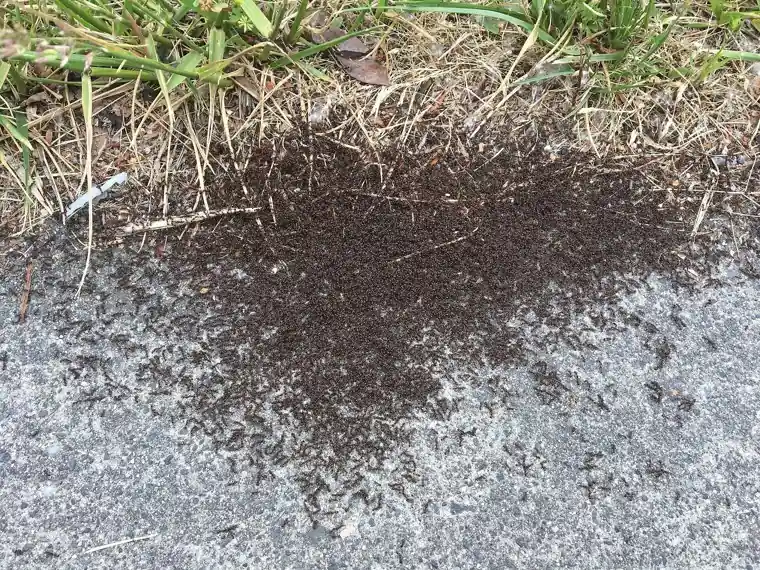
Concrete and pavers make ideal ant country. The slab or paver soaks up the sun and keeps the soil beneath warm and dry, and the joints give easy access. Landcare Research describes concrete paths and driveways as ant highways for Argentine ants, with trails running along their edges for long distances. Surface sprays on hot concrete also break down quickly, which is why they don't last.
The sand used to bed pavers is easy to dig, and ants push it up through the joints in neat piles. That's often the first sign of a nest under a patio or path. Over time it can loosen pavers, but the bigger issue is that the nest sits right beside the house, feeding trails inside.
Lawns and garden beds
Lawn nests are usually less of a problem than nests near the house. Small mounds in the lawn may be a native species that never comes inside and can be left alone. Nests in garden beds next to the house, under mulch, beneath pot plants and around shrub roots, are the ones that tend to send trails indoors.
Garden beds also host the aphids, scale insects and mealybugs that ants tend for honeydew. A busy trail up a citrus tree or a rose bush is a sign of this. Controlling the ants lets natural predators get at the sap-feeders. See ants farming aphids and scale.
Driveways, retaining walls and fences
Driveways, retaining walls and fence lines are travel routes as much as nest sites. Ants run along the edge of the driveway, through the gaps in timber retaining walls and along the bottom rail of fences. Timber retaining walls with soil behind them are especially popular, because they hold warmth and moisture together.
Treating these routes is how a technician breaks the connection between nests in the garden or next door and the house. On sections with long fence lines next to infested neighbours, this is where most of the outside effort goes.
What the technician does outside
An outdoor treatment starts with a walk around the whole section. The technician follows trails from the house outwards, marks the main nest areas and travel routes, identifies the species, and notes anything sensitive: vegetable gardens, ponds, beehives, drains and stormwater sumps, children's play areas, and where pets spend time. Then they price the work in writing.
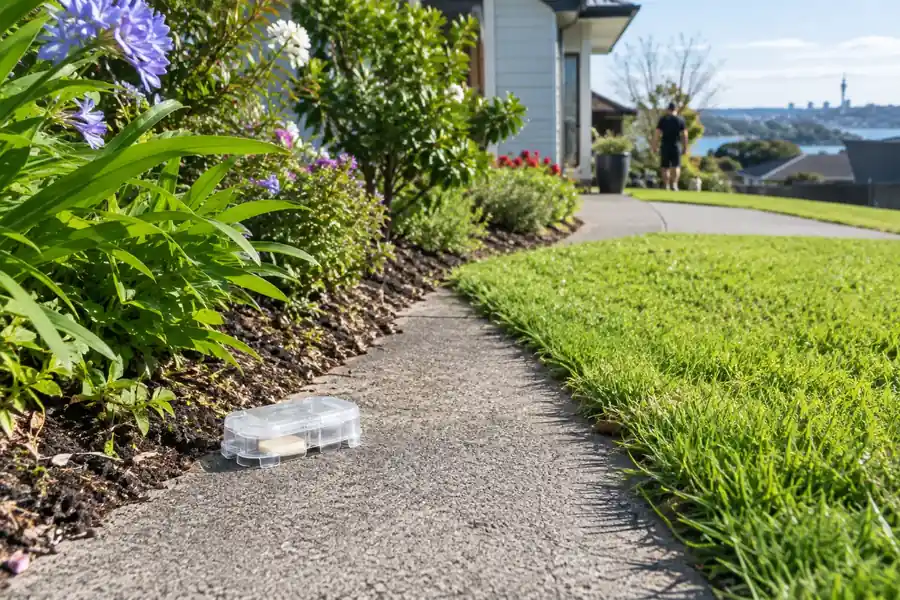
- Non-repellent product along path and driveway edges, paving joints near the house, the base of retaining walls and fence lines.
- Granular or bait products in garden beds and around nest entrances, where the ants carry them in.
- Bait stations on trails near play areas or where pets roam.
- No broad spraying of lawns, and products kept away from drains, water and flowering plants.
Keeping products out of drains and water
Outdoor products must be kept out of stormwater, because Auckland's stormwater flows straight to streams and the harbour. Technicians avoid treating directly around drains, sumps and grates, don't apply before heavy rain, and keep products off hard surfaces that wash into drains. Every product is applied to its label directions under the Hazardous Substances and New Organisms Act 1996.
If you have a pond, a stream at the bottom of the section, a water tank or beehives, say so when you book. The technician will plan placements around them.
After rain and in summer
Heavy rain floods nests and pushes ants up, often onto paths and into houses, and it can wash away some outdoor treatments. A sudden flush of ants after a storm doesn't always mean the treatment failed; numbers often settle again within days. Summer heat increases activity across the whole section.
If rain is forecast on the day of an outdoor treatment, the technician may adjust products or rebook part of the work. Ants after rain explains what's happening when trails appear after a downpour.
Fire ants: the exception
Most mounds in Auckland lawns are harmless. The exception to watch for is a mound of loose, fluffy soil with small reddish-brown ants that swarm out and sting painfully. That could be red imported fire ants, which are not established in New Zealand and are notifiable. Don't treat or disturb it.
What it costs
An outdoor-only treatment of paths and garden beds near the house usually sits within the published Auckland "from" prices of about $210 to $255 incl GST for one area or a small home. Inside and outside of a typical three-bedroom home is listed at about $340 to $400 incl GST. Large sections, long driveways and extensive retaining walls add time. You get a written price after the visit.
See what ant control costs for sources.
Ant control questions
Will the treatment kill my lawn or plants?
Products used to label directions won't harm the lawn or established plants. Flowering plants are avoided to protect bees.
Should I lift the pavers?
No. Treatment goes into the joints and edges. Lifting pavers disturbs the nest and scatters it.
Are all lawn ants a problem?
No. Native ants in the lawn are harmless and rarely come indoors. The technician will tell you which nests to leave alone.
Where these facts come from
Checked 5 November 2026