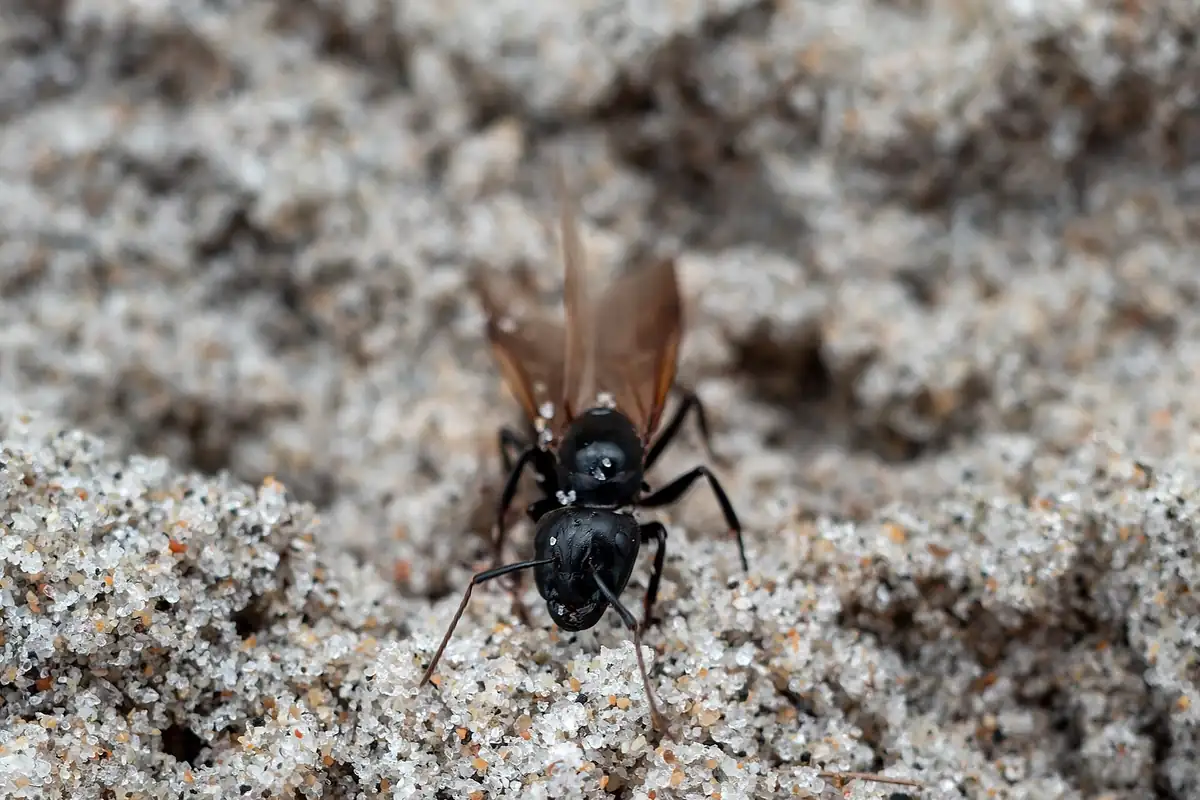

Flying ants are the winged males and young queens of an ant colony, and they leave the nest to mate. A few at a window on a warm, still day usually means a nest outside nearby and needs nothing more than a vacuum cleaner. Repeated emergences from inside a wall, skirting or ceiling suggest the nest is in the building, and that is worth a technician's visit. That is general guidance rather than a rule, so the visit's first job is finding out which it is.
What flying ants actually are
Ant colonies produce winged reproductives once they are established. Te Ara describes males with wings flying in swarms with young queens; after mating, the queens land, remove their wings and start new nests, while the males die soon after. Workers, the ants you usually see on trails, never have wings. So winged ants are a sign of a mature colony somewhere close.
Not every species does this the same way. Landcare Research notes that Argentine ant queens don't disperse by flying: they mate in the nest and the colony spreads by budding on foot. Winged ants in an Auckland house are therefore more likely to be another species, such as black house ants, white-footed house ants or native ants from the garden. How ant colonies work explains the life cycle.
Inside or outside: reading the signs
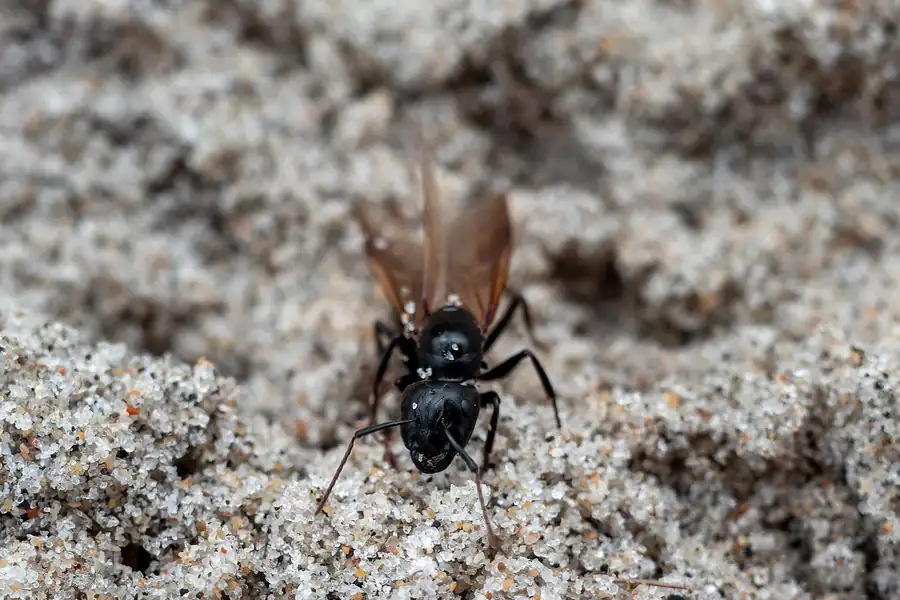
Where and how the winged ants appear is the best clue. A handful at an open window or door, all on one warm afternoon, usually came from a nest in the garden or a neighbouring section. Winged ants appearing repeatedly in the same room, crawling out from a skirting board, a light fitting, a power point or a gap in the ceiling, point to a nest inside the structure.
Things worth noting for the technician:
- the room and the exact spot where they appear, and the time of day
- whether it's a one-off or keeps happening over several days
- whether ordinary wingless workers trail from the same spot
- a few winged insects kept in a sealed bag or photographed close up
Ants, borer beetles or termites
People often call any small winged insect indoors a flying ant. In Auckland the main mix-ups are borer beetles, which emerge from timber through small round holes, and occasionally termites. Ants have a pinched "waist", elbowed antennae, and front wings that are larger than the back wings. Borer beetles are tiny brown beetles with hard wing cases.
If you find small round holes and fine powdery dust near where the insects appear, mention it: that points to borer, which is a different problem with different treatment. Damp, soft timber with insects in it suggests rot first. See ants in timber for how those overlap.
What the technician checks
The inspection traces the winged ants back to a nest. The technician looks at the emergence spot, nearby wall cavities, skirtings and ceiling edges, any sub-floor access, and the outside walls, eaves and gardens under the windows. They check whether wingless workers are trailing from the same area, which confirms an active colony there.
They'll also identify the species, because the treatment depends on it. White-footed house ants in a wall need generous bait close to where they feed. Black house ants take bait well. A garden nest that sent a swarm through the window may need nothing inside at all. You get a written price before anything is treated.
How a nest in the structure is treated
If the nest is in a wall, ceiling or sub-floor, the treatment goes to the nest, not the room. That typically means bait placed at the trails and near the emergence point, a non-repellent product or dust applied into the void through an existing gap where the label allows, and outside treatment at the entry points. The technician never sprays into a power point or light fitting.
Expect more activity for a few days as foragers feed, then a steady decline. Wall nests sometimes need a follow-up. The detail for cavity nests is on nests in walls and ceilings.
What to do in the meantime
Until the visit, keep things simple. Vacuum up winged ants rather than spraying them, empty the vacuum outside, and leave any wingless trail undisturbed so the technician can follow it. Don't fill or seal the gap they're coming from yet: it's the easiest route for treatment. Keep food covered and benches clean.
Repellent sprays at the emergence point tend to push the colony deeper into the wall. If you've already sprayed, tell the technician when you book. Preparing for a treatment has a short checklist.
When flying ants appear
In Auckland, mating flights are most often seen on warm, humid days in late spring and summer, often after rain. A swarm one afternoon and none for the rest of the year is typical of an outdoor nest. Winged ants appearing on cold days or out of season inside a heated house can mean a colony living in a warm wall.
That pattern is general experience rather than a published rule, so treat it as a guide. Ants in winter covers why some colonies stay active indoors.
What it costs
If the winged ants came from a garden nest, there may be nothing to treat inside. A nest in the structure usually means a targeted treatment of one area plus the outside wall, which sits around the published Auckland range of $210 to $255 incl GST for one area or a small home, or about $340 to $400 incl GST for inside and outside of a typical three-bedroom home.
The price is set in writing after the inspection. Sources are on what ant control costs.
Ant control questions
Do flying ants bite?
Not in any way that matters to people. They're focused on mating and dispersing, and most die within a day or two.
Will spraying the flying ants stop them?
It kills the ones you hit, but not the colony that produced them. If they keep appearing inside, the nest needs finding.
Are flying ants a sign of a big infestation?
They're a sign of a mature colony nearby. Whether it's in your walls or your neighbour's garden is what the inspection works out.
Where these facts come from
Checked 5 November 2026