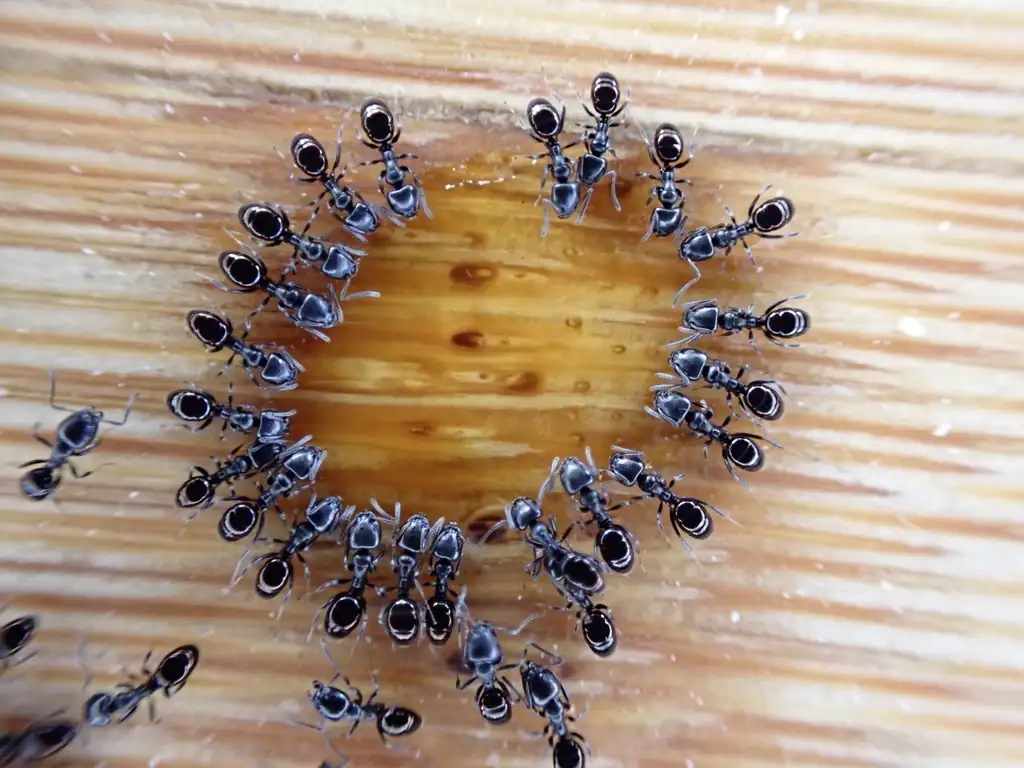
Black house ants are treated mainly with bait, because their workers share food with the rest of the colony and carry it back to the queens. A technician confirms the species, finds where the trail comes in and where the nest probably is, places bait along the active trail, and treats entry points outside with a product that won't scatter them. Most homes need one visit, with a check a few weeks later if the nest is in the structure.
What black house ants look like
The black house ant, *Ochetellus glaber*, is a small ant, only a few millimetres long and uniformly shiny black with no pale feet. It moves in thin, fairly slow trails, often along the edge of a bench, a window frame or a skirting board. It doesn't sting and has no strong smell when crushed. If the ants are black but have pale lower legs, they are more likely white-footed house ants, which need a different approach.
Landcare Research records the species as introduced from Australia, with the earliest New Zealand record a winged female collected at Whangārei Falls in 1927. It was well established by the late 1940s and is now common through the northern North Island, Auckland included. Telling house ants apart compares it with the other three common indoor ants.
Where they nest in and around a house
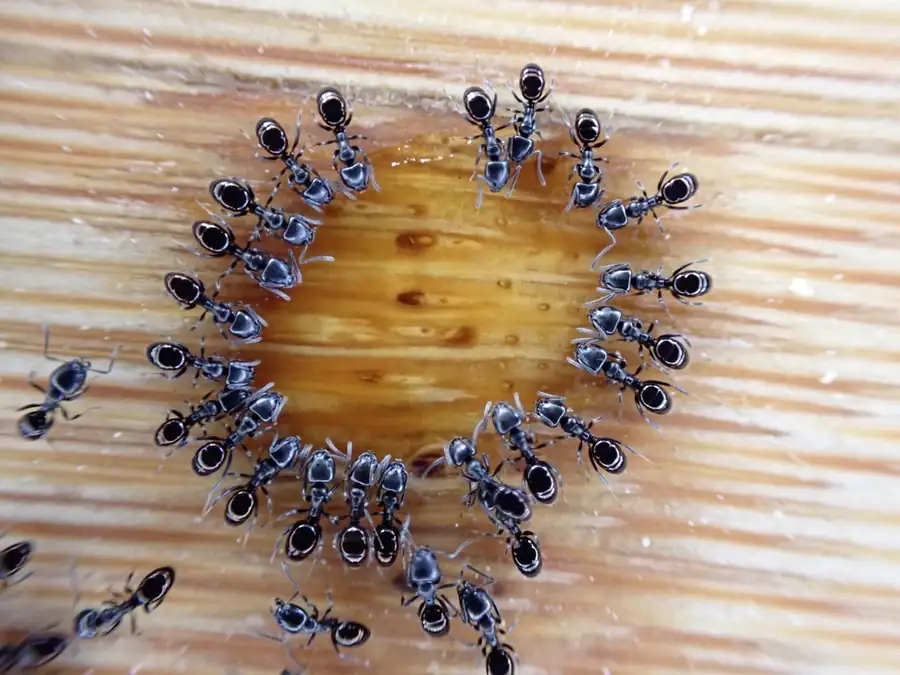
Black house ants nest both outdoors and inside buildings. Outside, they use dry spots under bark, in hollow stems, under pot plants and in cracks in walls and paths. Inside, they move into wall cavities, ceiling spaces and sub-floors, usually near warmth and a water source. Trails into the kitchen, bathroom and laundry are the usual sign.
In older Auckland homes with timber floors and plenty of small gaps, nests often sit in the sub-floor or the base of a wall, with trails surfacing along skirtings. In newer homes on concrete slabs they tend to come in at the slab edge, the garage door or around window joinery. The Pest Management Association notes they are not regarded as a major house pest in New Zealand, but a busy trail in the pantry is still a problem worth fixing properly.
Why bait usually works on this species
Bait suits black house ants because workers pass food to each other and to the brood. A slow-acting bait picked up on the bench ends up in the nest, even when nobody knows exactly where that nest is. The PMANZ guidance describes them as one of the easier ants to control for exactly this reason. The catch is that bait only works if the ants are still feeding from it.
That's why the most common reason for failure is spraying alongside the bait. A surface spray kills the foragers before they get home and makes the rest avoid the area. If you've already used a spray, tell the technician; they may need to bait slightly away from the sprayed strip. More on this in why sprays scatter ants.
What happens on the visit
A black house ant visit is usually short and focused. The technician asks what you've seen and used, confirms the species, follows the trail to where it enters the room or the building, and checks the outside walls, window frames and any pot plants near the doors. Then they price the job in writing and, if you agree, treat.
- Gel or liquid bait in small placements along the active trail, in cracks and behind appliances, or in closed stations where children or pets are around.
- A non-repellent treatment outside at the base of the wall where the trail comes in, and around window and door joinery.
- Where the nest is clearly in a wall or sub-floor, treatment targeted at that void.
- Aftercare advice: leave the trail alone for a few days, keep benches clean, and don't spray.
## How long it takes to clear
Expect more ants at the bait for the first day or two, which is a good sign: they're carrying it home. Numbers usually drop clearly within a week and the trail is gone within two. If there are still steady trails after two weeks, the bait isn't reaching one nest, often because there are two separate colonies, and a recheck is worth asking for.
Weather affects timing. A warm spell speeds up feeding; a cold, wet week slows it. How long treatment takes has the general timeline across species.
Keeping them out afterwards
Once the colony is gone, keeping black house ants out is mostly housekeeping and small repairs. Wipe benches at night, keep sugar and pet food sealed, and fix dripping taps and leaks under sinks, since moisture draws them in. Sealing gaps around window joinery and where pipes come through walls removes the easiest routes. Trim plants and branches touching the house.
The after a treatment page covers aftercare across all species, and kitchen ant treatment has more on food areas specifically.
When black ants turn out to be something else
Not every small black ant indoors is a black house ant. White-footed house ants are similar in size but have pale feet and live in large numbers inside wall cavities, and bait has to be used differently. Native ants occasionally wander in from bush-edge gardens and leave again on their own. Telling them apart on the visit saves you paying for the wrong treatment.
If the black ants have wings, the conversation changes: see flying ants. If they're coming out of power points or the top of a wall, see nests in walls and ceilings.
What it costs
Black house ant jobs are often limited to one area of the house plus the outside wall nearby, which sits at the lower end of published Auckland prices: about $210 to $255 incl GST for one area or a small home. A whole-house inside-and-outside treatment of a typical three-bedroom home is listed at about $340 to $400 incl GST. Your price is confirmed in writing after the technician has looked.
Ask whether a recheck is included and whether GST is in the figure. The sources for these ranges are on what ant control costs.
Ant control questions
Are black house ants dangerous?
No. They don't sting and aren't known to spread disease. They're a nuisance in food areas, which is why most people want them gone.
Should I put out shop bait first?
You can try a gel bait for a week or two, as long as you don't spray at the same time. If the trail hasn't thinned, the nest is out of reach.
Do black house ants damage the house?
They don't chew sound timber. If you find ants in soft or crumbling wood, the wood was already damp or rotten; see ants in timber.
Where these facts come from
Checked 5 November 2026